


BLOG
Read all our blogs here

Busy Is Not Profitable: The Scorecard Behind Business Freedom
Coach Archie Insights · ALS Solutions Inc.
By Archie Smith | Business Strategy Consultant, Executive Advisor & Performance Coach | ALS Solutions Inc.
Your business is growing. So why does your freedom keep shrinking?
Your revenue is increasing. Your customer base is expanding. You've hired additional employees, invested in technology, and filled your calendar with appointments. By almost every conventional measure, your business appears successful.
But there's a problem. You're working more hours than ever. Your employees still depend on you for critical decisions. Your expenses are increasing almost as quickly as your revenue. And despite all the growth, taking a two-week vacation without worrying about the business still feels impossible.
Congratulations. You've built a bigger business. But have you built a better one?
That's the question too many entrepreneurs never stop to ask. And it's the foundation of what I call The Scorecard Trap.
1. The Scorecard Trap: Measuring Activity Instead of Achievement
Every business has a scorecard, whether the owner formally maintains one or not. We track revenue, sales, leads, appointments, employees, production, and customer acquisition. These measurements are important. They help us understand what's happening inside our organizations.
But here's where entrepreneurs get into trouble: We start confusing the measurements with the mission.
Revenue becomes the goal instead of a means to achieve the goal. Growth becomes the objective instead of a strategy for achieving something more meaningful. And being busy becomes evidence of success rather than a potential warning sign.
Consider two hypothetical companies.
Company A:
| Company B:
|
Hypothetical comparison. Revenue alone does not establish financial strength.
Which business is more successful? The answer depends on what we're measuring.
Company A generates more revenue. Company B may provide greater profitability, flexibility, and operational resilience.
Without examining actual profits, cash flow, owner compensation, debt, and business value, we cannot determine which company is financially stronger.
But we can recognize something important. Revenue alone cannot tell us whether a business is creating freedom. That's why the numbers on your scorecard must connect to the outcomes you want.
2. Busy, Profitable, and Free Are Three Different Conditions
One of the most important distinctions an entrepreneur can make is understanding the difference between activity, profitability, and freedom.
Busy is an activity condition. It describes how much work is taking place.
Profitable is a financial condition. It describes whether the business generates an economic return after accounting for its costs.
Freedom is an ownership outcome. It describes the choices and flexibility available to the business owner.
These conditions can exist independently. A company can be busy without being profitable. It can be profitable while remaining completely dependent on its owner. And it can generate significant revenue without creating meaningful financial independence.
This distinction matters because entrepreneurs frequently solve the wrong problem.
When revenue slows, they assume they need more leads. When operations become overwhelming, they assume they need more employees. When administrative work increases, they assume they need more technology.
Sometimes those solutions are appropriate. But sometimes the underlying problem is poor pricing, unclear accountability, inefficient processes, weak margins, or a business model that depends too heavily on the owner's personal involvement.
The right solution begins with the right diagnosis.
3. The Five Steps to Freedom: Understanding Where Your Business Really Stands
At ALS Solutions, our coaching methodology recognizes five stages of business development:
Creation → Chaos → Control → Prosperity → Freedom
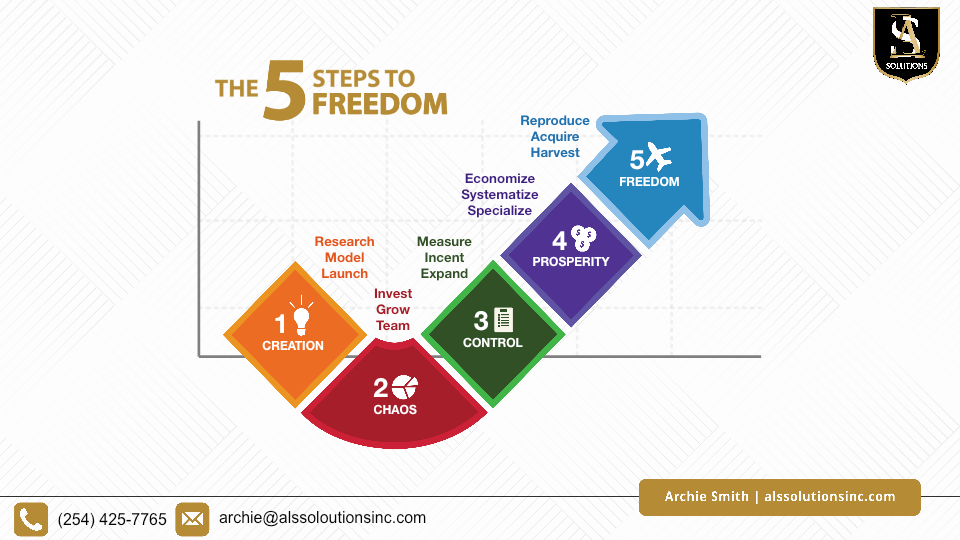
These stages describe a journey toward stronger operations, more sustainable performance, and greater choices for the owner.
Creation: Building the Foundation
During Creation, entrepreneurs establish their businesses, validate opportunities, develop offerings, and begin serving customers. The immediate challenge is turning an idea into a functioning enterprise.
At this stage, the owner often performs nearly every role. That's understandable. But the habits that help launch a business do not necessarily support its long-term growth.
Chaos: When Growth Creates Complexity
Chaos often begins when business activity exceeds the owner's ability to manage everything personally.
Customers increase. Employees are hired. Responsibilities multiply. But the underlying systems, accountability, and decision-making processes have not matured at the same pace.
This is where many successful-looking businesses become trapped. They're growing, but their operating structure cannot support that growth efficiently.
Control: Creating Predictability
Moving toward Control requires more than working harder. It requires understanding what drives results, identifying constraints, establishing accountability, and developing repeatable processes.
Owners begin replacing constant intervention with deliberate management. Instead of personally solving every problem, they create an organization increasingly capable of identifying and resolving problems.
Prosperity: Building Sustainable Performance
Prosperity involves strengthening the economic and operational performance of the business. Revenue matters, but so do margins, cash flow, customer value, organizational capability, and resilience. The business becomes better positioned to produce consistent results without requiring constant emergency intervention.
Freedom: Creating Meaningful Choices
Freedom does not necessarily mean retiring or leaving the business. Some entrepreneurs love operating their companies and want to remain actively involved. Others want more family time, opportunities to pursue additional ventures, financial independence, or the ability to build a lasting legacy.
The essential distinction is choice. Freedom means your involvement becomes increasingly intentional rather than compulsory. A business owner should be able to lead because they choose to—not because everything stops when they leave.
And here's the critical lesson: A business can increase revenue while remaining stuck in Chaos.
Growth does not automatically produce progress through the Five Steps. That requires intentional development.
4. The Three Constraints: Time, Team, and Money
At ALS Solutions, we examine business performance through three interconnected areas:
Time. Team. Money.
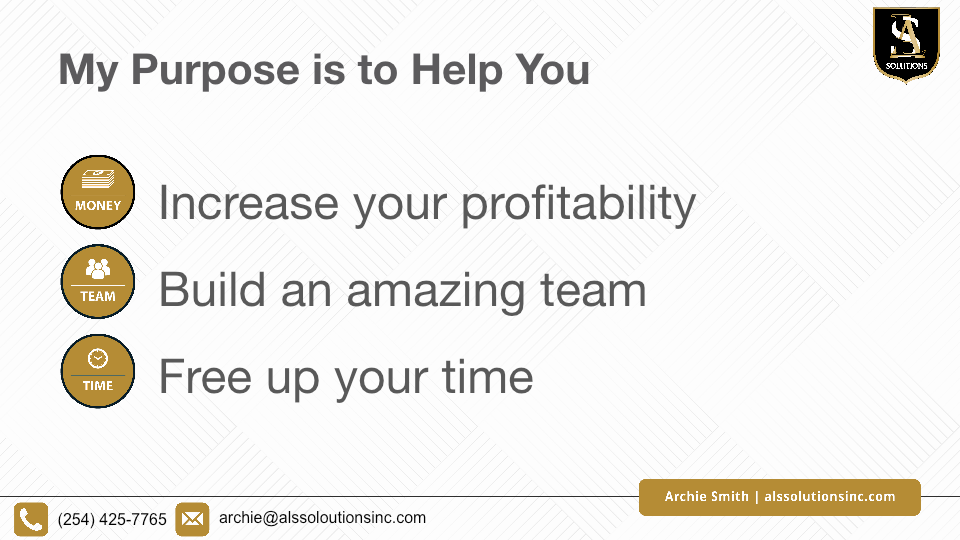
These areas help us identify why a business may be growing without becoming stronger.
TIME: Is Your Business Giving You Capacity—or Consuming It?
Many entrepreneurs begin their businesses seeking greater control over their time. Ironically, they sometimes end up working longer hours than they did as employees.
The problem isn't necessarily their work ethic. It may be the design of the business.
Ask yourself:
How many hours do I work each week?
How many decisions require my personal involvement?
Which responsibilities could be performed by someone else?
What happens when I'm unavailable?
Has business growth increased or decreased my available time?
Imagine an owner who hires three additional employees but continues approving every purchase, customer issue, and operational decision.
The company now has more people. But it hasn't necessarily gained more organizational capacity. It may have simply increased the number of people waiting for the owner.
A growing team should eventually reduce unnecessary owner dependence—not multiply it.
TEAM: Are You Building Leaders—or Collecting Dependents?
Hiring employees is not the same as developing an effective team. A capable organization requires clear responsibilities, appropriate authority, accountability, communication, and leadership.
Consider the difference between two managers. The first manager brings every problem to the owner and waits for instructions. The second understands the organization's objectives, evaluates options, makes appropriate decisions within established authority, and communicates results.
Both managers may be hardworking. But only one consistently reduces the owner's operational burden.
This raises an important leadership question: Are you building an organization that can think—or one that must constantly ask you what to think?
As businesses mature, owners must also develop their own leadership capabilities. The behaviors required to create a company are not always the same behaviors required to lead a growing organization.
At ALS, we connect that development to three leadership dimensions:
BE: Develop the character, judgment, and discipline required for the next stage.
KNOW: Understand your people, operations, numbers, and constraints.
DO: Establish systems, communicate expectations, delegate appropriately, and assess results.
Effective delegation is not abandoning responsibility. It's developing the capability to distribute responsibility without losing accountability.
MONEY: Are You Generating Revenue—or Creating Economic Value?
Revenue is one of the most visible business measurements. It's also one of the easiest to misunderstand.
Consider a simple hypothetical example. A company generates $100,000 in monthly revenue. Its direct costs, operating expenses, and other business obligations consume $97,000. The business retains only $3,000 before any additional adjustments that may be necessary to evaluate its true economic performance.
Now imagine revenue increases to $125,000. Sounds impressive. But if expenses increase to $124,000, the company may be busier while producing less financial benefit.
The revenue increased. The business did not necessarily become more profitable.
This is why entrepreneurs must examine:
Gross margins and operating margins
Cash flow and working capital
Customer acquisition costs
Pricing and service delivery economics
Debt and financial obligations
Owner compensation
Business value and sustainability
These measurements reveal different aspects of financial performance. No single number tells the entire story.
Revenue tells you how much business you're generating. Profitability helps reveal what the business retains. Cash flow helps determine whether the business can meet its obligations.
All three matter. And all three should support the owner's broader objectives.
5. The Owner-Freedom Test
Here's an exercise I encourage entrepreneurs to consider. Ask yourself one question:
THE OWNER-FREEDOM TEST
If my business grows exactly as it is currently designed, what happens to me?
Not what happens to revenue. Not what happens to the number of employees. Not what happens to the customer count. What happens to you?
Do you gain more time?
Do you become financially stronger?
Does your team become more capable?
Does your business become less dependent on your constant involvement?
Or do you simply become responsible for managing a larger version of the same problems?
This question forces us to examine the relationship between growth and organizational design.
If doubling your business would double your stress, workload, and decision-making burden, your current model may be scaling dependence rather than freedom.
The answer is not necessarily to stop growing. The answer may be to redesign how growth happens.
6. Build a Scorecard That Measures What Matters
A useful business scorecard should do more than describe activity. It should help owners understand performance and make better decisions.
Start by selecting one meaningful measurement from each of our three diagnostic areas.
Area | Example measurement | What it helps reveal |
|---|---|---|
Time | Weekly hours spent on routine operational decisions | Owner dependence |
Team | Percentage of routine decisions resolved within delegated authority | Organizational capability |
Money | Operating profit margin | Financial performance |
These are illustrations, not universal prescriptions. The right metrics depend on the business model and its current constraints.
Then ask five questions about each measurement:
1. What are we measuring? Define the metric clearly.
2. Why does it matter? Connect the measurement to a meaningful business objective.
3. What behavior does it encourage? Make sure the metric rewards the outcomes you actually want.
4. What improves when the number improves? Look for tangible operational or financial benefits.
5. Does this move the owner closer to freedom? Connect business performance to the owner's larger purpose.
For example, increasing sales appointments may appear positive. But if appointment quality declines, conversion rates fall, and the owner spends more time pursuing unqualified opportunities, the increase may not represent progress.
A better scorecard helps reveal those relationships. It tells you not only what is happening, but where to investigate.
7. Diagnose Before You Prescribe
One of the most expensive mistakes business owners make is purchasing solutions before understanding their problems.
They invest in marketing when the real issue is customer retention.
They hire additional employees when the real issue is process design.
They purchase software when the real issue is accountability.
They reduce prices when the real issue is communicating value.
These decisions may create more activity without solving the underlying constraint. That's why the ALS approach emphasizes diagnosis before prescription.
Different business owners need different starting points.
The ALS Business Scorecard provides an initial opportunity to examine broader business conditions.
A Complimentary Coaching Session can help an owner clarify challenges through conversation.
A Silver Bullet Call may be appropriate when a particular Time, Team, or Money constraint needs focused attention.
And when deeper financial or operational analysis is warranted, the ProfitDriver Analysis can help identify opportunities to strengthen business economics.
The goal is not to push every business owner toward the same service. It's to understand the situation and identify an appropriate next step. Because the most expensive solution is often the one that solves the wrong problem.
8. Your Business Should Serve Your Life
Entrepreneurship is about more than generating revenue. It can create opportunities to provide for families, develop people, serve communities, build financial independence, and establish a lasting legacy. But those outcomes require intention.
A business that consumes every available hour may provide income without providing flexibility. A company that depends entirely on its founder may generate revenue without creating a sustainable organization. And a growing enterprise with weak economics may create impressive activity without building lasting financial value.
The objective is not simply to become bigger. It's to become better.
Better systems. Better leadership. Better financial performance. Better choices. And ultimately, greater freedom.
So before you celebrate your next revenue milestone, ask yourself: Is my business becoming stronger—or am I simply becoming busier?
That answer may tell you more about your future than your revenue statement ever will.
Your Next Step: Find Out What Your Scorecard Is Really Telling You
If you're unsure whether your business is progressing toward greater profitability, stronger systems, and owner freedom, start with a diagnosis.
The ALS Business Scorecard can help you begin identifying areas that deserve attention across Time, Team, and Money.
Take the ALS Business Scorecard
Because the purpose of building a business isn't simply to create more work. It's to create something valuable enough to give you meaningful choices.
Revenue is a measurement. Freedom is an outcome.
Aspire 2 Ascend. Learn 2 Lead. Succeed 2 Serve.

Busy Is Not Profitable: The Scorecard Behind Business Freedom
Coach Archie Insights · ALS Solutions Inc.
By Archie Smith | Business Strategy Consultant, Executive Advisor & Performance Coach | ALS Solutions Inc.
Your business is growing. So why does your freedom keep shrinking?
Your revenue is increasing. Your customer base is expanding. You've hired additional employees, invested in technology, and filled your calendar with appointments. By almost every conventional measure, your business appears successful.
But there's a problem. You're working more hours than ever. Your employees still depend on you for critical decisions. Your expenses are increasing almost as quickly as your revenue. And despite all the growth, taking a two-week vacation without worrying about the business still feels impossible.
Congratulations. You've built a bigger business. But have you built a better one?
That's the question too many entrepreneurs never stop to ask. And it's the foundation of what I call The Scorecard Trap.
1. The Scorecard Trap: Measuring Activity Instead of Achievement
Every business has a scorecard, whether the owner formally maintains one or not. We track revenue, sales, leads, appointments, employees, production, and customer acquisition. These measurements are important. They help us understand what's happening inside our organizations.
But here's where entrepreneurs get into trouble: We start confusing the measurements with the mission.
Revenue becomes the goal instead of a means to achieve the goal. Growth becomes the objective instead of a strategy for achieving something more meaningful. And being busy becomes evidence of success rather than a potential warning sign.
Consider two hypothetical companies.
Company A:
| Company B:
|
Hypothetical comparison. Revenue alone does not establish financial strength.
Which business is more successful? The answer depends on what we're measuring.
Company A generates more revenue. Company B may provide greater profitability, flexibility, and operational resilience.
Without examining actual profits, cash flow, owner compensation, debt, and business value, we cannot determine which company is financially stronger.
But we can recognize something important. Revenue alone cannot tell us whether a business is creating freedom. That's why the numbers on your scorecard must connect to the outcomes you want.
2. Busy, Profitable, and Free Are Three Different Conditions
One of the most important distinctions an entrepreneur can make is understanding the difference between activity, profitability, and freedom.
Busy is an activity condition. It describes how much work is taking place.
Profitable is a financial condition. It describes whether the business generates an economic return after accounting for its costs.
Freedom is an ownership outcome. It describes the choices and flexibility available to the business owner.
These conditions can exist independently. A company can be busy without being profitable. It can be profitable while remaining completely dependent on its owner. And it can generate significant revenue without creating meaningful financial independence.
This distinction matters because entrepreneurs frequently solve the wrong problem.
When revenue slows, they assume they need more leads. When operations become overwhelming, they assume they need more employees. When administrative work increases, they assume they need more technology.
Sometimes those solutions are appropriate. But sometimes the underlying problem is poor pricing, unclear accountability, inefficient processes, weak margins, or a business model that depends too heavily on the owner's personal involvement.
The right solution begins with the right diagnosis.
3. The Five Steps to Freedom: Understanding Where Your Business Really Stands
At ALS Solutions, our coaching methodology recognizes five stages of business development:
Creation → Chaos → Control → Prosperity → Freedom
These stages describe a journey toward stronger operations, more sustainable performance, and greater choices for the owner.
Creation: Building the Foundation
During Creation, entrepreneurs establish their businesses, validate opportunities, develop offerings, and begin serving customers. The immediate challenge is turning an idea into a functioning enterprise.
At this stage, the owner often performs nearly every role. That's understandable. But the habits that help launch a business do not necessarily support its long-term growth.
Chaos: When Growth Creates Complexity
Chaos often begins when business activity exceeds the owner's ability to manage everything personally.
Customers increase. Employees are hired. Responsibilities multiply. But the underlying systems, accountability, and decision-making processes have not matured at the same pace.
This is where many successful-looking businesses become trapped. They're growing, but their operating structure cannot support that growth efficiently.
Control: Creating Predictability
Moving toward Control requires more than working harder. It requires understanding what drives results, identifying constraints, establishing accountability, and developing repeatable processes.
Owners begin replacing constant intervention with deliberate management. Instead of personally solving every problem, they create an organization increasingly capable of identifying and resolving problems.
Prosperity: Building Sustainable Performance
Prosperity involves strengthening the economic and operational performance of the business. Revenue matters, but so do margins, cash flow, customer value, organizational capability, and resilience. The business becomes better positioned to produce consistent results without requiring constant emergency intervention.
Freedom: Creating Meaningful Choices
Freedom does not necessarily mean retiring or leaving the business. Some entrepreneurs love operating their companies and want to remain actively involved. Others want more family time, opportunities to pursue additional ventures, financial independence, or the ability to build a lasting legacy.
The essential distinction is choice. Freedom means your involvement becomes increasingly intentional rather than compulsory. A business owner should be able to lead because they choose to—not because everything stops when they leave.
And here's the critical lesson: A business can increase revenue while remaining stuck in Chaos.
Growth does not automatically produce progress through the Five Steps. That requires intentional development.
4. The Three Constraints: Time, Team, and Money
At ALS Solutions, we examine business performance through three interconnected areas:
Time. Team. Money.
These areas help us identify why a business may be growing without becoming stronger.
TIME: Is Your Business Giving You Capacity—or Consuming It?
Many entrepreneurs begin their businesses seeking greater control over their time. Ironically, they sometimes end up working longer hours than they did as employees.
The problem isn't necessarily their work ethic. It may be the design of the business.
Ask yourself:
How many hours do I work each week?
How many decisions require my personal involvement?
Which responsibilities could be performed by someone else?
What happens when I'm unavailable?
Has business growth increased or decreased my available time?
Imagine an owner who hires three additional employees but continues approving every purchase, customer issue, and operational decision.
The company now has more people. But it hasn't necessarily gained more organizational capacity. It may have simply increased the number of people waiting for the owner.
A growing team should eventually reduce unnecessary owner dependence—not multiply it.
TEAM: Are You Building Leaders—or Collecting Dependents?
Hiring employees is not the same as developing an effective team. A capable organization requires clear responsibilities, appropriate authority, accountability, communication, and leadership.
Consider the difference between two managers. The first manager brings every problem to the owner and waits for instructions. The second understands the organization's objectives, evaluates options, makes appropriate decisions within established authority, and communicates results.
Both managers may be hardworking. But only one consistently reduces the owner's operational burden.
This raises an important leadership question: Are you building an organization that can think—or one that must constantly ask you what to think?
As businesses mature, owners must also develop their own leadership capabilities. The behaviors required to create a company are not always the same behaviors required to lead a growing organization.
At ALS, we connect that development to three leadership dimensions:
BE: Develop the character, judgment, and discipline required for the next stage.
KNOW: Understand your people, operations, numbers, and constraints.
DO: Establish systems, communicate expectations, delegate appropriately, and assess results.
Effective delegation is not abandoning responsibility. It's developing the capability to distribute responsibility without losing accountability.
MONEY: Are You Generating Revenue—or Creating Economic Value?
Revenue is one of the most visible business measurements. It's also one of the easiest to misunderstand.
Consider a simple hypothetical example. A company generates $100,000 in monthly revenue. Its direct costs, operating expenses, and other business obligations consume $97,000. The business retains only $3,000 before any additional adjustments that may be necessary to evaluate its true economic performance.
Now imagine revenue increases to $125,000. Sounds impressive. But if expenses increase to $124,000, the company may be busier while producing less financial benefit.
The revenue increased. The business did not necessarily become more profitable.
This is why entrepreneurs must examine:
Gross margins and operating margins
Cash flow and working capital
Customer acquisition costs
Pricing and service delivery economics
Debt and financial obligations
Owner compensation
Business value and sustainability
These measurements reveal different aspects of financial performance. No single number tells the entire story.
Revenue tells you how much business you're generating. Profitability helps reveal what the business retains. Cash flow helps determine whether the business can meet its obligations.
All three matter. And all three should support the owner's broader objectives.
5. The Owner-Freedom Test
Here's an exercise I encourage entrepreneurs to consider. Ask yourself one question:
THE OWNER-FREEDOM TEST
If my business grows exactly as it is currently designed, what happens to me?
Not what happens to revenue. Not what happens to the number of employees. Not what happens to the customer count. What happens to you?
Do you gain more time?
Do you become financially stronger?
Does your team become more capable?
Does your business become less dependent on your constant involvement?
Or do you simply become responsible for managing a larger version of the same problems?
This question forces us to examine the relationship between growth and organizational design.
If doubling your business would double your stress, workload, and decision-making burden, your current model may be scaling dependence rather than freedom.
The answer is not necessarily to stop growing. The answer may be to redesign how growth happens.
6. Build a Scorecard That Measures What Matters
A useful business scorecard should do more than describe activity. It should help owners understand performance and make better decisions.
Start by selecting one meaningful measurement from each of our three diagnostic areas.
Area | Example measurement | What it helps reveal |
|---|---|---|
Time | Weekly hours spent on routine operational decisions | Owner dependence |
Team | Percentage of routine decisions resolved within delegated authority | Organizational capability |
Money | Operating profit margin | Financial performance |
These are illustrations, not universal prescriptions. The right metrics depend on the business model and its current constraints.
Then ask five questions about each measurement:
1. What are we measuring? Define the metric clearly.
2. Why does it matter? Connect the measurement to a meaningful business objective.
3. What behavior does it encourage? Make sure the metric rewards the outcomes you actually want.
4. What improves when the number improves? Look for tangible operational or financial benefits.
5. Does this move the owner closer to freedom? Connect business performance to the owner's larger purpose.
For example, increasing sales appointments may appear positive. But if appointment quality declines, conversion rates fall, and the owner spends more time pursuing unqualified opportunities, the increase may not represent progress.
A better scorecard helps reveal those relationships. It tells you not only what is happening, but where to investigate.
7. Diagnose Before You Prescribe
One of the most expensive mistakes business owners make is purchasing solutions before understanding their problems.
They invest in marketing when the real issue is customer retention.
They hire additional employees when the real issue is process design.
They purchase software when the real issue is accountability.
They reduce prices when the real issue is communicating value.
These decisions may create more activity without solving the underlying constraint. That's why the ALS approach emphasizes diagnosis before prescription.
Different business owners need different starting points.
The ALS Business Scorecard provides an initial opportunity to examine broader business conditions.
A Complimentary Coaching Session can help an owner clarify challenges through conversation.
A Silver Bullet Call may be appropriate when a particular Time, Team, or Money constraint needs focused attention.
And when deeper financial or operational analysis is warranted, the ProfitDriver Analysis can help identify opportunities to strengthen business economics.
The goal is not to push every business owner toward the same service. It's to understand the situation and identify an appropriate next step. Because the most expensive solution is often the one that solves the wrong problem.
8. Your Business Should Serve Your Life
Entrepreneurship is about more than generating revenue. It can create opportunities to provide for families, develop people, serve communities, build financial independence, and establish a lasting legacy. But those outcomes require intention.
A business that consumes every available hour may provide income without providing flexibility. A company that depends entirely on its founder may generate revenue without creating a sustainable organization. And a growing enterprise with weak economics may create impressive activity without building lasting financial value.
The objective is not simply to become bigger. It's to become better.
Better systems. Better leadership. Better financial performance. Better choices. And ultimately, greater freedom.
So before you celebrate your next revenue milestone, ask yourself: Is my business becoming stronger—or am I simply becoming busier?
That answer may tell you more about your future than your revenue statement ever will.
Your Next Step: Find Out What Your Scorecard Is Really Telling You
If you're unsure whether your business is progressing toward greater profitability, stronger systems, and owner freedom, start with a diagnosis.
The ALS Business Scorecard can help you begin identifying areas that deserve attention across Time, Team, and Money.
Take the ALS Business Scorecard
Because the purpose of building a business isn't simply to create more work. It's to create something valuable enough to give you meaningful choices.
Revenue is a measurement. Freedom is an outcome.
Aspire 2 Ascend. Learn 2 Lead. Succeed 2 Serve.

Privacy Policy | Terms and Conditions